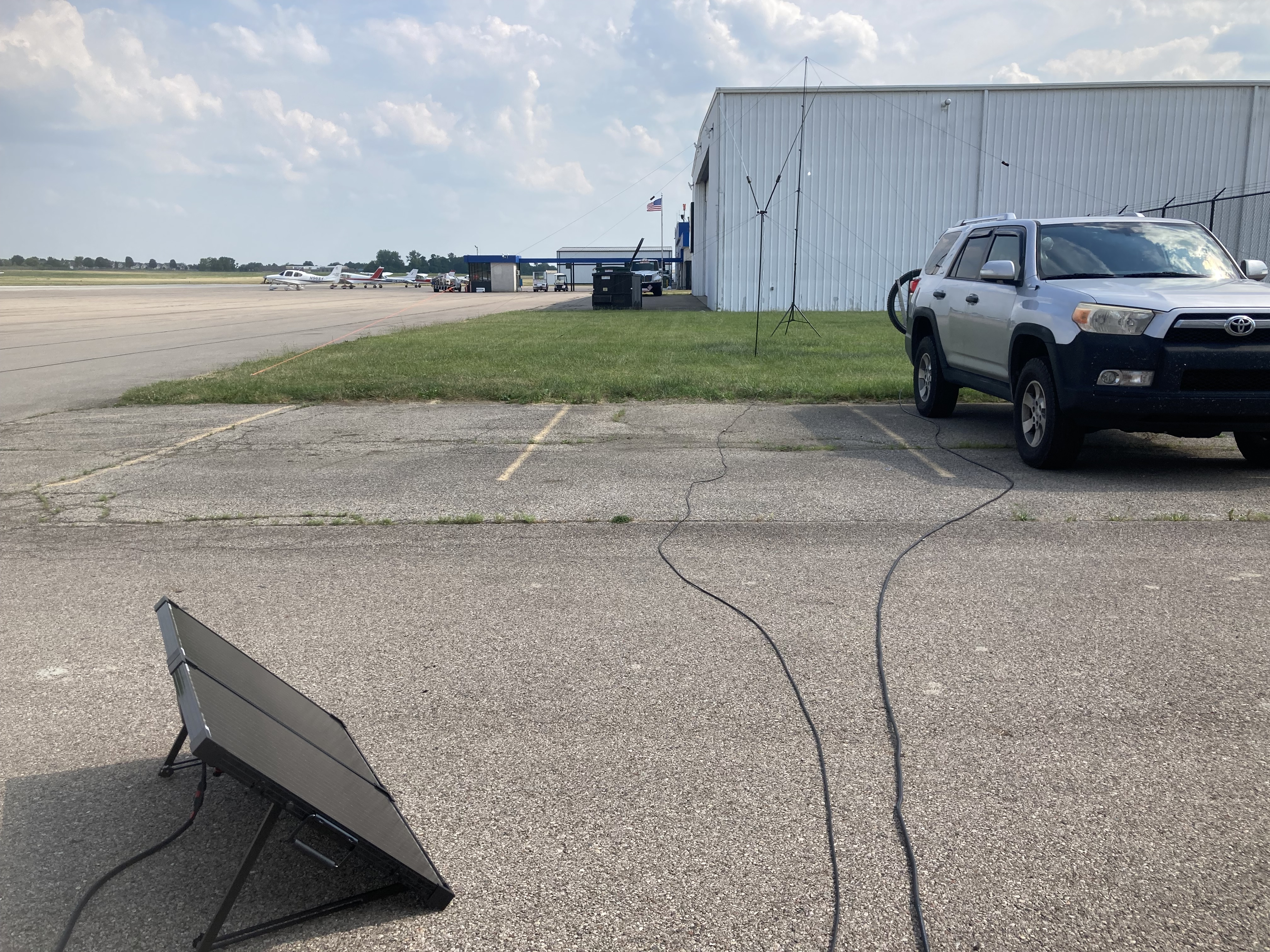
RBCC WX8S operated ARRL Field Day at a local General Aviation airport. Signs were posted encouraging visitors. Nearly all 50 states were worked during the event.
20m during the day and 40m at night generated the most points. 80m was sparse as was 10m at the time. 15m had some activity.
The setup:
- 80m/40m/20m crossed dipole array on 18ft mast
- 20m/15m/10m sloping dipole on short portable mast
- Semi-Portable Remote Base HF radio setup
- Portable HF radio
- Bandpass filters on 40m and 20m
- Deep cycle battery being charged via solar
- Laptops running electronic logging


What we learned this time:
- A 100Ah deep cycle battery and boost regulator can power two HF radios running ~50W each for a 24 hour event.
- Surprisingly the sloping dipole on short portable mast worked better than the 20m part of the crossed dipole on the tall mast.
- It is hard to get outside people on to operate/participate.
What we would do differently next time:
- More efficient network shared computer logging was needed than our default HAMRS running on separate devices – got a license for N3FJP after the event.
- Some sort of intercom/headset system with foot press-to-talk switches that allow radio positions to operate next to each other with less distraction. Aviation headset adapters may be a good fit for this application.
- Better self-contained power distribution from the battery/solar system and boost regulator all placed in a convenient easy to carry box that matches the Remote Base HF radio setups.
- Use a second Semi-Portable Remote Base HF Radio setup once the 2nd such system is built.
- Get additional bandpass filters, specifically 15m (got one after the event). 80m and 10m would be beneficial if running 3 radios or more full time.
- What would be really neat are diplexers allowing multiple radios to run off a single antenna, specifically a 80m/40m diplexer for regional and NVIS contacts on the crossed dipole and a 20m/15m/10m for longer range contacts for a new antenna we are planning to add to the works. The downside to this is a high cost of entry.
- Find a way to remote base the setup on a local LAN so as to allow operating position to be anywhere on premises not limited by antenna location and coax runs. This will also isolate the airport ramp noise of helicopters and transient jet aircraft from interfering.
We plan to implement some of these changes by Winter Field Day in January.
 Remote Base Contest Club